Wednesday, February 17, 2016
Monday, February 15, 2016
Engaging Young Writers-Chapters 1 and 2
Welcome to the "Engaging Young Writers" book study. Follow along with me, Kristen's Kindergarten, Maggie's Kinder Corner and Mrs. Price's Kindergators as we read and reflect. Please feel free to add your own comments-we love collaboration!
Question 1: How does bookmaking encourage children to be writers?
At our school, using the Lucy Calkins' writing UOS, has helped our students to see themselves as authors. This is the underlying idea in each session- students as authors. When you talk to children as authors they begin to see their favorite writers as peers and try to recreate their favorite conventions. Here you see a student who wanted to imitate his favorite non-fiction books. So he wrote a fact about dolphins on each page and added an illustration to match.
During our
read alouds we have developed a routine of examining the texts to
identify features that interest us-like the speech bubbles of Mo Willems books or the side page previewing in Jan Brett's "The Mitten". The more our students integrate their favorite ideas the more they take ownership of their writing.
Question 2: How do you honor approximations?
Developing self-efficacy as a writer is difficult for some young students because they feel as if correct spelling is the goal of writing. If they don't get it right, that can destroy their confidence. Dispelling this myth while coaching them through the writing process can be a feat. In my class, I use this chart to help students understand that their kid spelling is good enough.
This idea was a take away from Katie Wood Ray's book "About the Authors". It helps students not to microfocus on conventions and spelling, but it frees them up to try different techniques from their favorite authors.
Question 1: What kind of writing do you tend to lead your students towards?
I'm not sure why, but I think I automatically lead my kids towards personal narratives. They like to write about trips, their favorite toy, etc. One thing that I love about the UOS, is that students are doing teaching books in the beginning, so they are writing about a self-selected topic.It could be their family, an animal or a TV show- it's their choice!
Question 2: How does the idea of various entry points fit into your classroom writing routine?
The idea of entry points is an effective way to differentiate for young students. Glover states that, "The more meaningful writing is to the child, the more energy he will have for writing". This is so true! I have looked across the room and witnessed a student who appears to be in agony at the thought of writing another word. Great teachers know that "low energy" must be counteracted with an entry point that has meaning for that child.
I'm not sure why, but I think I automatically lead my kids towards personal narratives. They like to write about trips, their favorite toy, etc. One thing that I love about the UOS, is that students are doing teaching books in the beginning, so they are writing about a self-selected topic.It could be their family, an animal or a TV show- it's their choice!
Question 2: How does the idea of various entry points fit into your classroom writing routine?
The idea of entry points is an effective way to differentiate for young students. Glover states that, "The more meaningful writing is to the child, the more energy he will have for writing". This is so true! I have looked across the room and witnessed a student who appears to be in agony at the thought of writing another word. Great teachers know that "low energy" must be counteracted with an entry point that has meaning for that child.

Sunday, January 31, 2016
Sharing Sunday-February

Sunday, January 3, 2016
Sharing Sunday-January
Head back to the Primary Peach for more January resources!

Sunday, November 29, 2015
Sharing Sunday-December
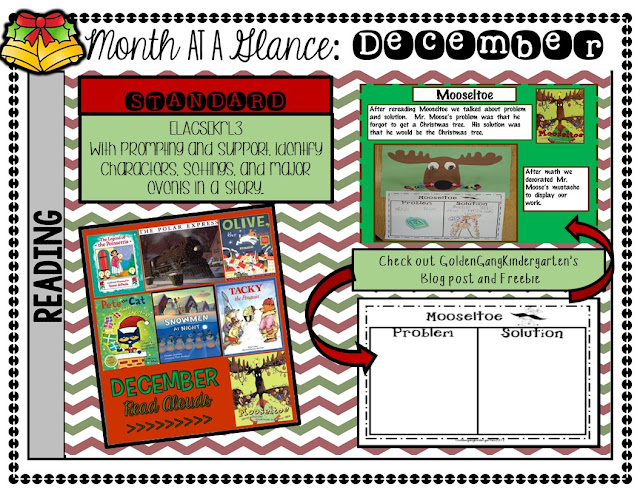
These are some of my absolute favorite holiday books-especially Mooseltoe! Check out GoldenGang Kindergarten's blog post, which has some great activities to go with this book.
SCORE! I think I've found my NEW favorite holiday book-Stick Man. It's about a stick who is trying to find his way back to his Family tree during the holidays. It has rhyming words, repetitive phrases and would be great for sequencing. I did not find a lot of kindergarten friendly resources for this book so I will likely create my own, including an activity where my students can transform their stick into another object.
I love this activity because students can do this multiple times by comparing their name with several of their classmates'. They can compare the number of circles, numerals and also determine which snowman is taller/shorter than another.

Sunday, November 22, 2015
Using Padlet in the Classroom
I'm blogging over at The Primary Peach about Using Padlet in the Classroom
Click on the image below to check out my blog post!

Friday, November 20, 2015
Retelling of the First Thanksgiving
Padlet is one of my favorite tools to use to collaborate inside the classroom and beyond our four walls. This week we retold the events of the First Thanksgiving using the ShowMe app and then used Padlet to store all of our videos. It makes them so much easier to access when they are housed in one place.


Subscribe to:
Posts (Atom)